The regulatory context and the need for Automation
In recent years, European regulations on anti-money laundering (AML) and counter-terrorism financing have become increasingly stringent. Regulation (EU) 2024/1624, part of the “AML Package,” introduces important provisions in the field of anti-money laundering, including enhanced management of the frequency of client verification checks. Based on a risk-based approach, it requires obligated entities—such as banks and other financial institutions—to conduct periodic and ongoing reviews of clients based on the associated risk. The frequency of these checks is tailored according to the risk assessment and the nature of the business relationship.
Continuous monitoring obligations have been strengthened to identify any significant changes in customers’ risk profiles. This includes the collection and updating of data on the beneficial owner and other necessary information to ensure ongoing due diligence.
These requirements have placed considerable pressure on operators, who must manage increasing volumes of checks while ensuring compliance with increasingly complex regulations. In this context, automation appears to be the only efficient way to address these complex and repetitive processes.
The use of advanced technologies, such as Artificial Intelligence (AI), in the field of AML and compliance could mark a significant breakthrough for companies operating in a progressively demanding regulatory environment.
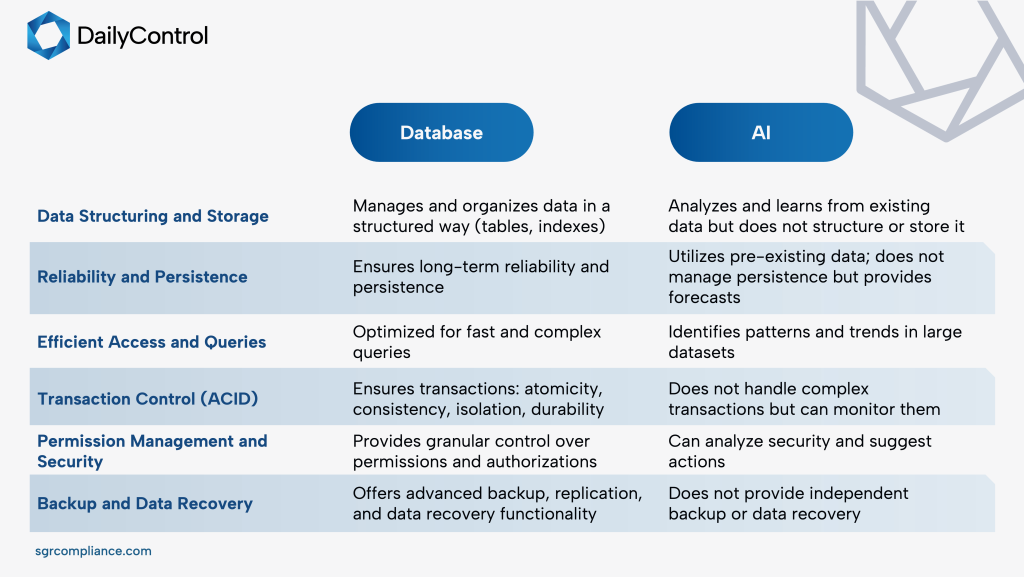
While AI seems to be a strategic tool for optimizing AML procedures, it is crucial to understand its limitations and strengths. For these tools to realize their full potential, it is essential to recognize the distinct and complementary roles of databases and AI, as well as to adopt a strategy based on data quality and targeted automation.
The European Parliament defines AI as:
“[…]the ability of a machine to display human-like capabilities such as reasoning, learning, planning and creativity. AI enables technical systems to perceive their environment, deal with what they perceive, solve problems and act to achieve a specific goal. The computer receives data – already prepared or gathered through its own sensors such as a camera – processes it and responds. AI systems are capable of adapting their behaviour to a certain degree by analysing the effects of previous actions and working autonomously.”
When discussing AI in the context of compliance, it’s important to start with a fundamental premise highlighted in the European Parliament’s definition: AI works towards a specific goal by processing pre-existing data. AI does not generate new information; it simply processes, examines, analyzes, and correlates data that already exists within a defined framework, such as a catalog or database.