Instant Payments: the importance of live sanctions screening.

On 19 March 2024, Regulation (EU) 2024/886 of the European Parliament and of the Council, approved on 13 March 2024, was published in the Official Journal of the European Union. This regulation introduces amendments to Regulations (EU) No. 260/2012 and (EU) 2021/1230, as well as to Directives 98/26/EC and (EU) 2015/2366, with the objective of updating the rules relating to instant payments in euros.

The Regulation aims to standardise and promote the use of instant payments (IPs) in euros across all countries in the SEPA (Single Euro Payments Area)*. As part of the ongoing evolution of the SEPA project, the use of instant payments is intended to encourage competition, advance the payments market, develop new euro-denominated payment products, and facilitate the entry of new market operators.

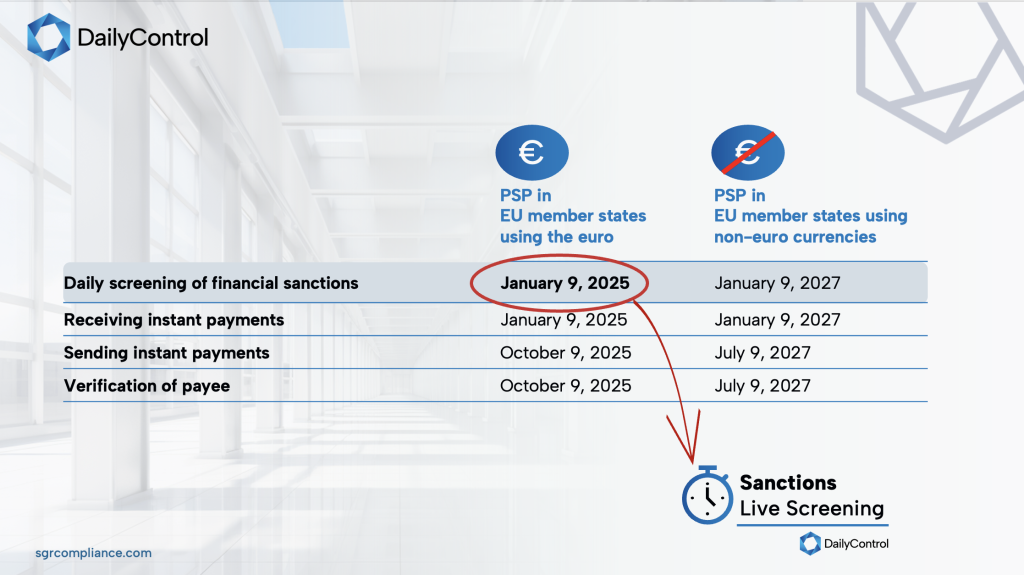
By 9 January 2025, financial intermediaries must comply with the requirements set out in the Regulation, referred to as the “Instant Payments Regulation (IPR)”:

  • Providing the service of receiving instant payments in euros (the obligation to guarantee the sending service is instead required by 9 October);
  • Carrying out daily checks on targeted financial sanctions.

Furthermore, PSPs in EU member states using the euro must comply with requirements to verify the identity of the payee by implementing dedicated systems (“Verification of Payee”, VOP) by 9 October 2025, while those in member states using non-euro currencies must comply by 9 July 2027.

 

What impact does it have on due diligence procedures?

In the case of instant payments, the Regulation revises the transaction-screening paradigm for counterparties in favour of continuous verification of payment service users (PSUs) before operations are conducted, aimed at reducing procedural burdens and delays.

As outlined in the Regulation, screening the payer and payee in each domestic or cross-border transaction results in a large number of flagged payments potentially linked to persons or entities subject to targeted financial sanctions. However, most flagged transactions are found, upon verification, to have no such association, leading to numerous false positives that require management. Given the nature of instant payments, this often prevents PSPs from verifying flagged operations within the required timeframes, resulting in rejected transactions.

To improve the efficiency and reliability of the system, the Regulation requires PSPs to verify daily whether PSUs are subject to such measures, avoiding checks on each transaction. Periodic checks concern only the targeted financial sanctions adopted under Article 215 TFEU, including asset freezes and prohibitions on making economic resources available to certain persons or entities.

The Regulation specifies that customer checks must be performed:

  • Immediately after the entry into force of new targeted financial sanctions;
  • Immediately after any changes to such measures;
  • At least once per calendar day.

SGR has already implemented an advanced solution that allows sanctions to be reviewed and updated multiple times per day, ensuring compliance with up-to-date information and providing optimal support for regulatory compliance.


How does SGR provide “live” sanctions updates?

Regarding continuous and at-least-daily screening of targeted sanctions, SGR is ready to support its clients in adapting to the new regulatory requirements by offering an advanced solution for accessing “live” updates on sanctions.

This solution allows near real-time consultation of changes to targeted financial sanctions imposed by international sanctions regimes, such as:

  • European Union (EU): “Consolidated List of Travel Bans” and “Consolidated Financial Sanctions”;
  • United Nations (UN): “United Nations Security Council Consolidated List”;
  • Office of Foreign Assets Control (OFAC): “Specially Designated Nationals And Blocked Persons List (SDN)” and “Consolidated Sanctions List (Non-SDN Lists)”;
  • United Kingdom (UK): “The UK Sanctions List”;
  • Swiss State Secretariat for Economic Affairs (Seco): “Sanktionsadressaten.”

To provide PSPs with this module, SGR has scheduled the consultation of sources on an hourly basis, exceeding the daily requirement indicated by the Regulation.
The updated information is then structured, validated, deduplicated, and integrated into a database for client access. This process ensures that operators base their checks on constantly updated data, reducing risk exposure and operating in compliance with regulatory provisions.

With the 9 January 2025 deadline approaching, we encourage financial intermediaries to contact us to learn how to best implement the “live” sanctions updates system. Our team of experts is available to analyse the specific needs of your organisation and propose tailored solutions, ensuring a straightforward and effective compliance process.


What are the other provisions of the Regulation?

1. Obligation to provide instant payments:

The Regulation requires all payment service providers (PSPs) to offer this transfer method, guaranteeing transaction execution within 10 seconds, 24 hours a day, 7 days a week. PSPs must provide both sending and receiving services for instant payments in euros, with any applicable fees not exceeding those charged for standard transfers. Specifically, from 9 January 2025, all eurozone PSPs must enable customers to receive instant payments, while the obligation to provide sending services will begin on 9 October 2025.

2. Verification of payee identity (“Verification of Payee”):

The Regulation introduces specific security measures to protect funds during instant payment execution. PSPs must offer users of payment services (USPs) an immediate verification service for the recipient’s identity. This verification will take place after the payer provides the necessary beneficiary information and before authorising the transfer, without additional costs. In cases of incorrect operation due to an error in verification, the payer’s PSP must immediately reimburse the amount of the payment.

3. Continuous and at-least-daily checks of targeted financial sanctions:

As detailed above, PSPs must verify whether their customers are individuals or entities subject to targeted financial sanctions under Article 215 TFEU.

4. Sanctions:

Member states must ensure that penalties for breaches of customer verification obligations include:

  • For legal entities: Maximum administrative fines of at least 10% of total annual net turnover in the previous financial year;
  • For individuals: Maximum administrative fines of at least €5,000,000 or an equivalent amount in national currency for member states not using the euro, as of 8 April 2024.

5. Reporting:

PSPs must submit an annual report to the national competent authorities, detailing the level of fees (distinguishing between standard payments, instant payments, and payment accounts) and the proportion of rejections due to the application of targeted financial sanctions.

Thanks to the data and technological solutions SGR provides to its clients and partners, controls can be automated, compliance processes optimised, and rapid responses to new regulatory provisions ensured.

* * *

*SEPA is a unified area where euro transactions are executed according to uniform standards. SEPA includes EU countries, both within and outside the eurozone, as well as certain non-EU countries.

Ready to streamline your compliance processes?

Reach out now to explore tailored strategies and tools designed to meet your organization's unique needs. Let’s work together to turn compliance challenges into opportunities!

Subscribe to our newsletter for the latest insights and events.