The FRC Leaders’ Convention (Frankfurt, 19-20.02.2026) is a premier industry forum bringing together senior leaders and professionals in compliance, AML, financial crime risk management, and fraud prevention across the DACH region (Germany, Austria, and Switzerland) and the wider European regulatory landscape. Designed for heads of compliance, AML and fraud teams, risk executives, and regulatory stakeholders, the event provides a high-level platform for strategic exchange, best practice benchmarking, and actionable insight into strengthening financial crime frameworks in a region characterised by strong cross-border exposure and complex risk interdependencies.
FRC Leaders’ Convention – DACH, Frankfurt 2026.
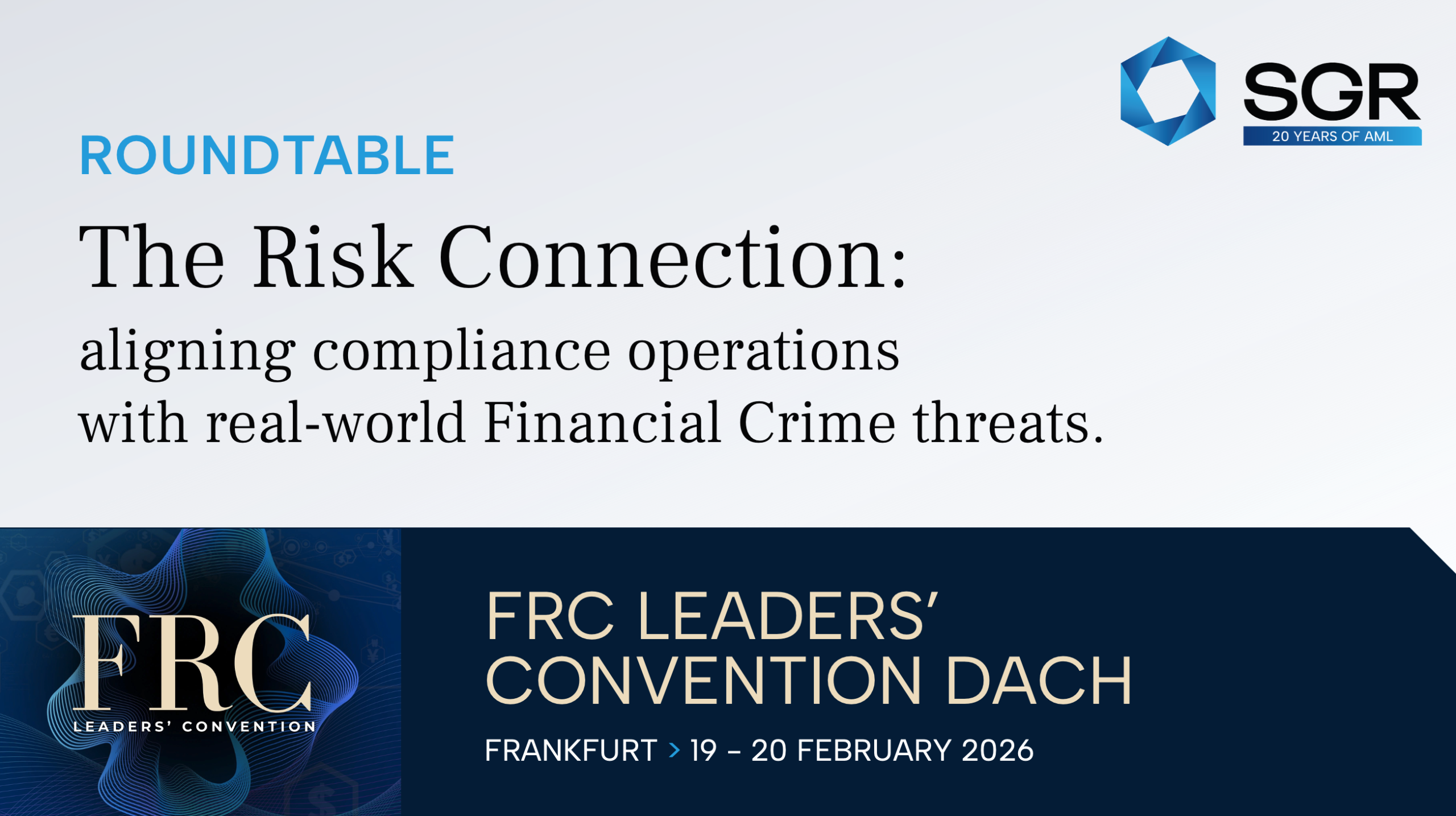
Our Roundtable: “The Risk Connection”
We will be hosting and leading the roundtable discussion “The Risk Connection: aligning compliance operations with real-world Financial Crime threats”. The session will be led by Valentina Gilberti, Product Success Manager, and moderated as a practitioner-focused exchange among senior peers.
This session is designed for Heads of Compliance, Heads of Financial Crime, AML Directors and senior decision-makers responsible for setting strategy and operational priorities: access to the right data, professional-grade analytical tools, and technology that genuinely supports human decision-making.
Rather than discussing compliance in abstract terms, the roundtable will concentrate on how financial crime risk manifests in practice and how operations can be structured to detect, understand and act on those risks efficiently.
The discussion will focus on:
-
Accessing the right data at the right moment: adverse media, sanctions, corporate data, network and contextual information that allows analysts to understand why a risk exists, not just that it exists.
-
Using professional investigation and analysis tools to surface hidden relationships, indirect exposures and nested risk clusters that are invisible through entity-by-entity screening alone.
-
Designing workflows where technology augments human expertise, allowing analysts and investigators to spend time on higher-value judgment, contextual analysis and escalation, rather than manual data gathering.
-
Reducing operational friction by replacing fragmented tools and siloed views with integrated, purpose-built solutions that support investigations end-to-end.
-
Making better use of human-in-the-loop models, where advanced analytics and automation support—not replace—experienced compliance professionals, freeing resources to focus on complex cases and broader risk activities.
Organized crime and hidden risk networks: a practical perspective
The roundtable will also draw on practical know-how about the DACH context where cross-border economic activity and complex corporate structures create fertile ground for organized crime and mafia-style infiltration of the legal economy.
Rather than approaching these risks at a theoretical level, the discussion will focus on how such threats actually emerge in data and operational workflows, and on the concrete challenges faced by compliance and investigation teams when risk is fragmented, indirect, or deliberately obscured:
-
Detect organized crime infiltration into the legal economy, including indirect exposure through corporate structures and intermediaries;
-
Unveil hidden relationships and network-based risk clusters, where criminal risk is nested and not immediately visible at single-entity level;
-
Support compliance teams with advanced analytical and technical tools that move beyond traditional name-based screening toward contextual, network-driven risk identification.