Accelerate and save on manual work with the right tools.

Time, Resources, and Completeness of Information. These are the three key variables, inherently limited in nature, within due diligence procedures that can impact their efficiency and effectiveness.

If your procedures for due diligence on customers, suppliers, and counterparties during the onboarding phase are already well planned and efficient, continuous monitoring risks being neglected due to certain critical issues, such as:


  • Costs and lack of dedicated personnel;
  • Data complexity (checks from different sources and on a wide spectrum of information);
  • Outdated IT systems;
  • Non-uniform processes across business functions.
1. Why is it important to review existing relationships?

During ongoing relationships, the risk of obsolescence of the information collected during the onboarding phase is very high, necessitating active intervention to update data, such as demographic and commercial information.

Similarly, it is essential to know new elements that potentially impact the risk profile associated with the subjects concerning anti-money laundering (AML), anti-fraud, anti-corruption, and counter-terrorist financing (CTF) checks.


2. What are the benefits of updating data?

Identify new contacts within a legal entity and verify real exposure to risk.

Discover new roles acquired by a subject in companies not previously screened, which may operate in higher-risk sectors.

Gain visibility on involvement in legal proceedings, political appointments, sanctions, or measures affecting subjects after onboarding.


3. How to allocate resources for data updates?

Compliance resources will never be sufficient to constantly manage the volume of subjects and their updates manually. The process is not scalable without automation. It is essential to invest in professional tools and automate repetitive activities to:

  • avoid focusing on repetitive procedures with uncertain outcomes – for instance, scheduling the verification of a subject every three months does not guarantee updated information.
  • maximise the skills and expertise within your department, allowing internal human intelligence to focus on higher value-added activities.


Our Automated Monitoring

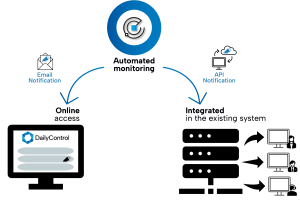
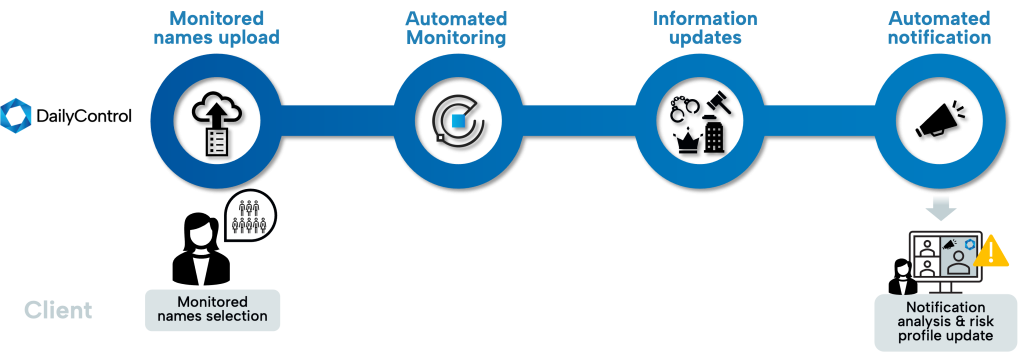
Automated monitoring workflow

The Daily Control™  solution includes the Automated Monitoring function that:

1. verifies daily any new updates that may affect the monitored names online or via API;
2. alerts when there is data to be noted, activating resources only when necessary;

saving time and resources, optimising investment in dedicated tools, increasing the efficiency of procedures.

How to access Automated Monitoring

Did you know you can also monitor...?

Commercial information: 

  • For legal entities – financial statements, company searches, shareholder lists, changes in office holders or qualifications, extraordinary events like mergers, transfers, liquidations.

Monitoring corporate changes helps prevent fraud and illicit activities, as companies can quickly react to warning signs like frequent changes of directors or suspicious modifications in the corporate structure. Monitoring can highlight changes in the corporate structure, changes in administrative bodies, changes of registered office, mergers, acquisitions, and more.

  • For individuals – Daily Control exclusively offers the possibility to monitor both role changes and the acquisition of new positions within other companies.

Exclusively, SGR has developed and extended monitoring to individuals to intercept not only changes within the same corporate structure but also new associations that could pose additional risks. Tracking movements allows for continuous evaluation of associated risks or links with non-compliant entities.


Information relevant to AML, Anti-Fraud, CTF:

The newly identified people (individuals and legal entities) and the subjects already being monitored are compared daily with the datasets in Daily Control (Adverse Media, PEPs, Local Politicians, Sanctions, and watchlists).

When changes and new evidence related to the monitored names are detected and added to the database, a notification is sent to the operator.

Updates can refer to the entity (identification data, address, tax code, …) or the connected evidence (proceedings for predicate offences of money laundering, increased political exposure, sanctions, or measures against the subject or associated entities).

Resources of obligated subjects are activated only when their expertise and analysis are required, optimising the number of activities involved.

The client can foresee an alert system linked to specific cases, such as the involvement of the monitored name in a particular crime.

Subscribe to the Automated Monitoring

Automated monitoring is available on the Daily Control online platform and can also be integrated into existing systems via API.

Subscribe to our newsletter for the latest insights and events.