Rethinking AML Effectiveness.

12.06.26

From risk data to real outcomes

The discussions at Economic Crime Prevention Europe 2026 highlighted a clear and accelerating shift across the compliance landscape: effectiveness is becoming the primary benchmark against which AML and financial crime frameworks are assessed.

Across topics ranging from sanctions and due diligence to AI and geopolitical risk, the same underlying challenge emerged consistently — organisations are not lacking information, but they often struggle to turn that information into timely, actionable, and demonstrable outcomes.

The growing gap between intelligence and control

Financial institutions today have access to an unprecedented volume of intelligence: regulatory guidance, typologies, enforcement cases, sanctions developments, and external risk data. However, a critical gap persists. Too often, this intelligence:

  • Remains fragmented across different functions and teams
  • Is difficult to translate into operational rules or controls
  • Is not continuously updated or tested
  • And ultimately fails to drive real-time decision-making

This creates a structural friction between what organisations know and what they are able to act upon.
The key issue is no longer data availability, but data usability.
To meet supervisory expectations, organisations must demonstrate that intelligence is not only collected, but effectively embedded into control frameworks — supporting detection, decision-making, and measurable risk mitigation.

Moving beyond static compliance

Another recurring theme is the increasing distance between traditional compliance models and current risk realities. Static approaches — periodic reviews, siloed control environments, manual processes — are no longer sufficient in a context defined by:

  • Rapidly evolving geopolitical risks
  • Increasingly complex sanctions regimes
  • Cross-border ownership structures
  • New forms of technology-enabled financial crime

The direction of travel is clear: compliance must become more continuous, adaptive, and outcome-driven.

This requires a fundamental evolution in how organisations design their operating models, ensuring that risk assessment, controls, and monitoring are not separate layers, but part of a connected and dynamic cycle.

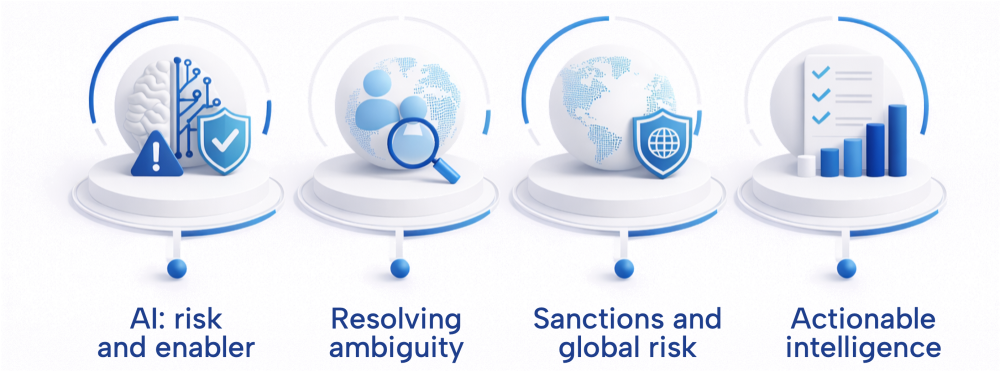
1. AI as both a risk and an enabler

Artificial intelligence is playing a dual role in this transformation.

On one side, it is raising the level of threat. The ability to generate highly sophisticated, synthetic content — including documents, identities, and supporting evidence — introduces new challenges in areas such as onboarding, due diligence, and investigations. Criminal organisations are increasingly exploiting AI themselves, leveraging it to create convincing fake documentation, manipulate identities, and scale fraudulent activities with a level of speed and realism that was previously difficult to achieve. This evolution not only increases the volume of potentially malicious inputs but also makes detection significantly more complex, requiring institutions to adopt more advanced, technology-enabled approaches to validation and analysis.

On the other side, AI is becoming essential to managing complexity at scale. When properly implemented, it enables organisations to:

  • review and validate large volumes of information
  • detect anomalies and hidden patterns
  • reduce false positives
  • prioritise more effectively
  • and support continuous monitoring.

However, one principle remains critical: AI-driven processes must be explainable.

In a regulatory environment that increasingly focuses on outcomes and accountability, organisations must be able to understand, justify, and evidence the decisions supported by technology. Transparency is a core component of effectiveness.


2. Resolving ambiguity: the central role of identity and context
A persistent challenge in financial crime prevention is the accurate identification of individuals and entities.

Names alone are insufficient, particularly in a global context where:

  • multiple individuals may share the same identifiers
  • information is distributed across languages and jurisdictions
  • and relevant data is often unstructured

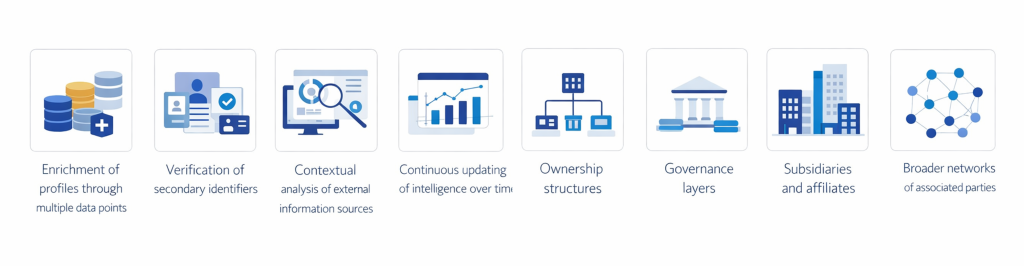
Reducing ambiguity requires a more sophisticated approach based on:

  • enrichment of profiles through multiple data points
  • verification of secondary identifiers
  • contextual analysis of external information sources
  • and continuous updating of intelligence over time

More importantly, risk must be understood as relational, not isolated.

Whether dealing with legal entities or individuals, effective assessment depends on the ability to map and analyse:

  • ownership structures
  • governance layers
  • subsidiaries and affiliates
  • and broader networks of associated parties

Only by building this comprehensive view can organisations accurately assess exposure and avoid blind spots.


3. Sanctions and global risk: from static screening to dynamic understanding

Sanctions and trade-related risks are becoming more complex, more dynamic, and more interconnected with broader geopolitical developments. In this context, traditional screening approaches remain a fundamental component of any control framework, but on their own are no longer sufficient. What matters is not only whether a control exists, but whether it reflects real-world exposure, including:

  • indirect ownership links
  • supply chain dependencies
  • jurisdictional overlaps
  • and rapidly evolving regulatory expectations.

This reinforces the need for more flexible and responsive frameworks, capable of integrating multiple sources of intelligence and adapting to change in near real-time.

Click here and read more about the importance of live sanctions screening.


4. Towards continuous, actionable intelligence
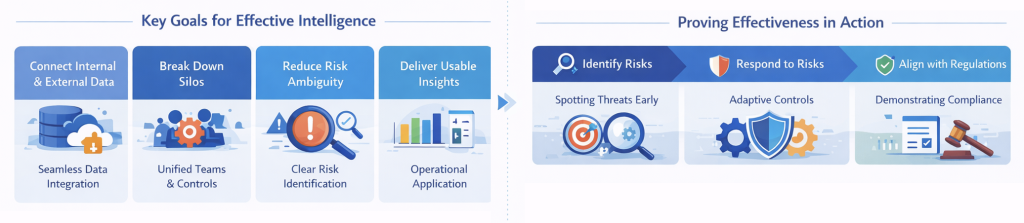
The overarching conclusion is clear: the future of financial crime prevention lies in the ability to operationalise intelligence continuously and at scale. This means moving towards models that:

  • connect internal and external data seamlessly
  • eliminate fragmentation between teams and controls
  • reduce ambiguity in risk identification
  • and deliver insights that are immediately usable in operational processes.

Effectiveness, in this context, is the ability to:

  • demonstrate how risks are identified
  • show how controls respond to those risks
  • and prove that outcomes align with regulatory expectations.
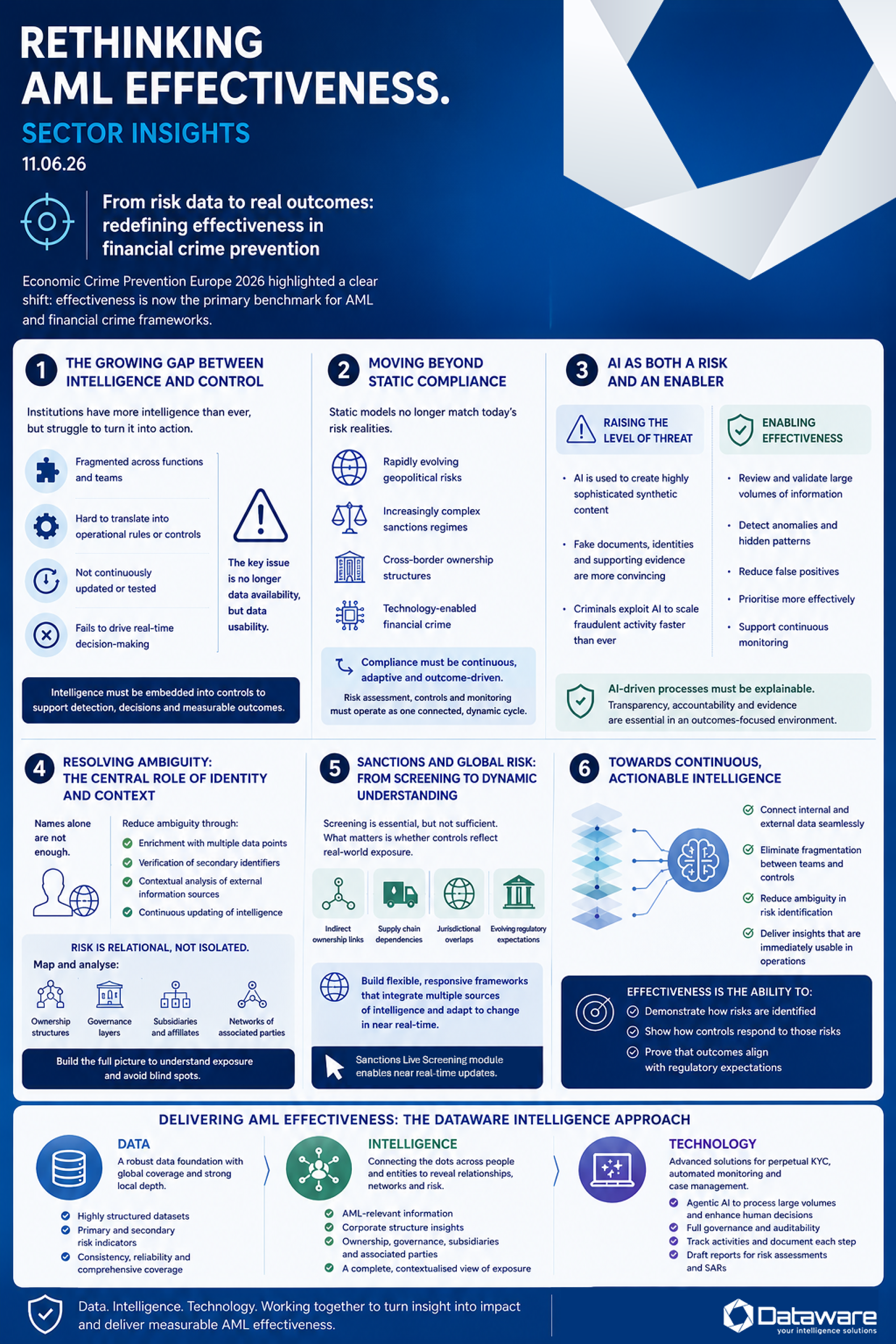
 

Delivering AML effectiveness: the Dataware Intelligence approach

Data

Structured data you can rely on to assess risk with confidence.

Dataware Intelligence provides a robust data foundation combining global coverage with strong local depth, supported by highly structured datasets enriched with both primary and secondary risk indicators. This ensures consistency, reliability, and a comprehensive basis for risk analysis.

Intelligence

Seeing beyond entities, understanding connections.

Building on this, our intelligence capabilities enable organisations to connect the dots across individuals and legal entities, uncovering relationships, networks, and potential risk factors. This includes both AML-relevant information and corporate structure insights, allowing for a more complete and contextualised understanding of exposure.

Technology

Supporting decisions with automation, scalability and control.

These capabilities are delivered through advanced software solutions designed for perpetual KYC, automated monitoring, and case management. Leveraging agentic AI, our platform processes large volumes of data efficiently, supporting and enhancing human decision-making. At the same time, it ensures full governance by enabling users to track activities, document each step, and generate draft reports for key processes such as risk assessments and suspicious activity reporting — providing an end-to-end, effective approach to financial crime prevention.

Every organisation has its own challenges, structures and risk profile. Let’s explore together how Dataware Intelligence can support you in strengthening AML effectiveness — contact us to start the conversation.

Contact us

Subscribe to our newsletter for the latest insights and events.