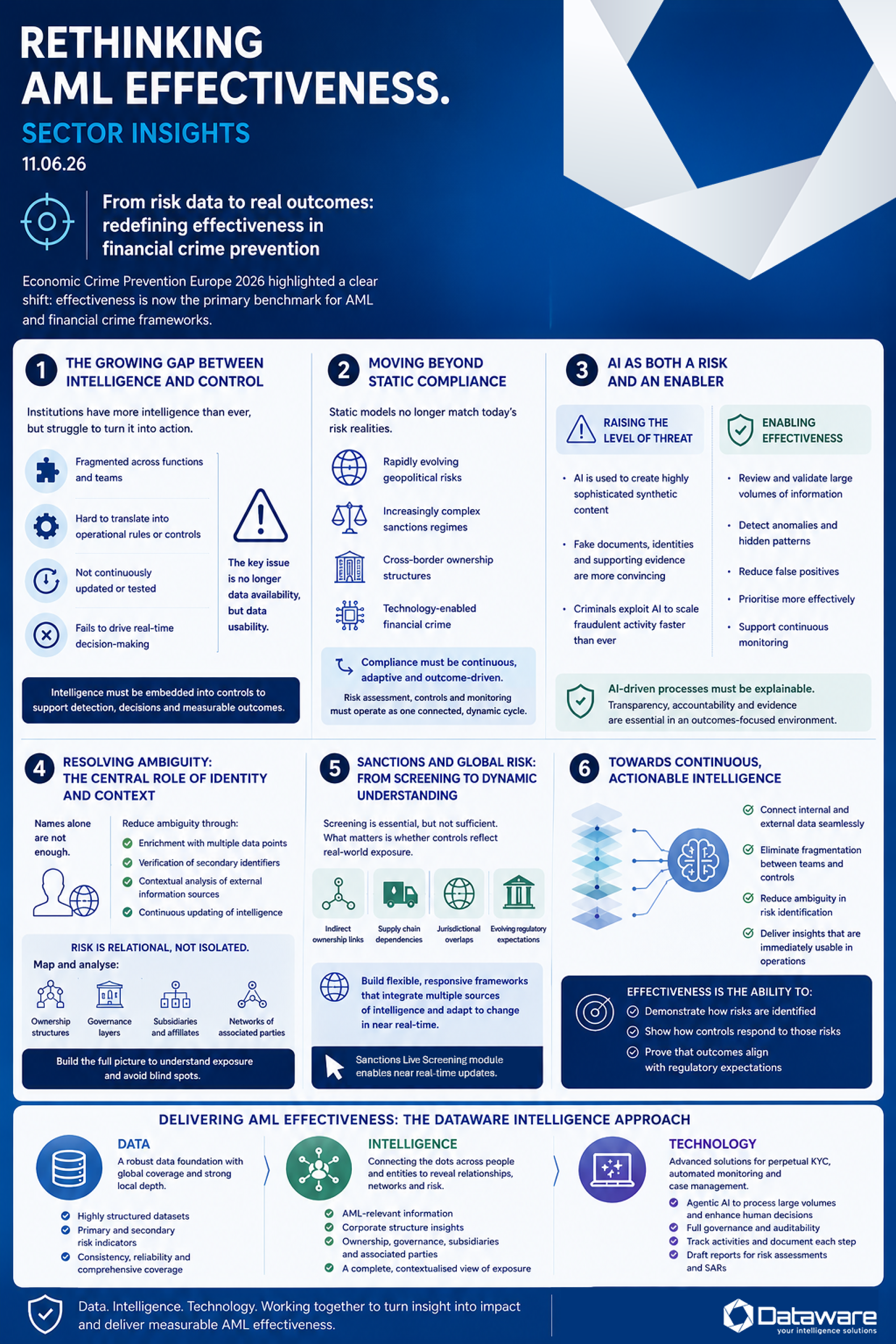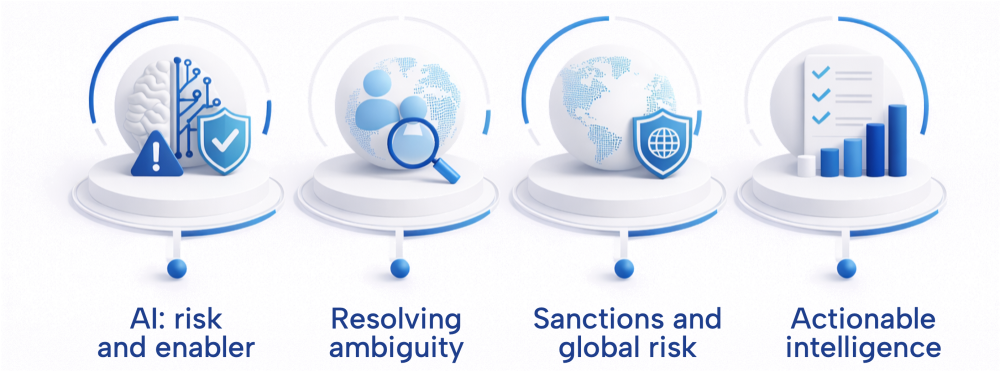
1. AI as both a risk and an enabler
Artificial intelligence is playing a dual role in this transformation.
On one side, it is raising the level of threat. The ability to generate highly sophisticated, synthetic content — including documents, identities, and supporting evidence — introduces new challenges in areas such as onboarding, due diligence, and investigations. Criminal organisations are increasingly exploiting AI themselves, leveraging it to create convincing fake documentation, manipulate identities, and scale fraudulent activities with a level of speed and realism that was previously difficult to achieve. This evolution not only increases the volume of potentially malicious inputs but also makes detection significantly more complex, requiring institutions to adopt more advanced, technology-enabled approaches to validation and analysis.
On the other side, AI is becoming essential to managing complexity at scale. When properly implemented, it enables organisations to:
- review and validate large volumes of information
- detect anomalies and hidden patterns
- reduce false positives
- prioritise more effectively
- and support continuous monitoring.
However, one principle remains critical: AI-driven processes must be explainable.
In a regulatory environment that increasingly focuses on outcomes and accountability, organisations must be able to understand, justify, and evidence the decisions supported by technology. Transparency is a core component of effectiveness.
2. Resolving ambiguity: the central role of identity and context

A persistent challenge in financial crime prevention is the accurate identification of individuals and entities.
Names alone are insufficient, particularly in a global context where:
- multiple individuals may share the same identifiers
- information is distributed across languages and jurisdictions
- and relevant data is often unstructured
Reducing ambiguity requires a more sophisticated approach based on:
- enrichment of profiles through multiple data points
- verification of secondary identifiers
- contextual analysis of external information sources
- and continuous updating of intelligence over time
More importantly, risk must be understood as relational, not isolated.
Whether dealing with legal entities or individuals, effective assessment depends on the ability to map and analyse:
- ownership structures
- governance layers
- subsidiaries and affiliates
- and broader networks of associated parties
Only by building this comprehensive view can organisations accurately assess exposure and avoid blind spots.
3. Sanctions and global risk: from static screening to dynamic understanding
Sanctions and trade-related risks are becoming more complex, more dynamic, and more interconnected with broader geopolitical developments. In this context, traditional screening approaches remain a fundamental component of any control framework, but on their own are no longer sufficient. What matters is not only whether a control exists, but whether it reflects real-world exposure, including:
- indirect ownership links
- supply chain dependencies
- jurisdictional overlaps
- and rapidly evolving regulatory expectations.
This reinforces the need for more flexible and responsive frameworks, capable of integrating multiple sources of intelligence and adapting to change in near real-time.
Click here and read more about the importance of live sanctions screening.
4. Towards continuous, actionable intelligence
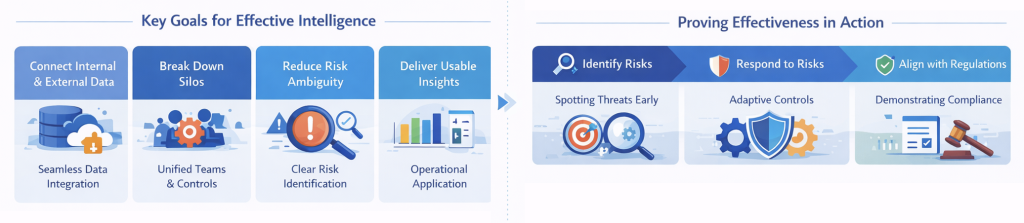
The overarching conclusion is clear: the future of financial crime prevention lies in the ability to operationalise intelligence continuously and at scale. This means moving towards models that:
- connect internal and external data seamlessly
- eliminate fragmentation between teams and controls
- reduce ambiguity in risk identification
- and deliver insights that are immediately usable in operational processes.
Effectiveness, in this context, is the ability to:
- demonstrate how risks are identified
- show how controls respond to those risks
- and prove that outcomes align with regulatory expectations.